Tuesday, April 16, 2013

What 2nd graders teach me

Yesterday afternoon I had the pleasure of helping out with a tour group from the nearby Catholic grade school in Maryville, MO.  These 2nd graders just made their first communion on Sunday.  

I remember making my first communion many years ago and thinking I was a 'big person' now that I could go to communion and not have to stay back in the pew while everyone deserted me and went up to do something I couldn't really make out.  


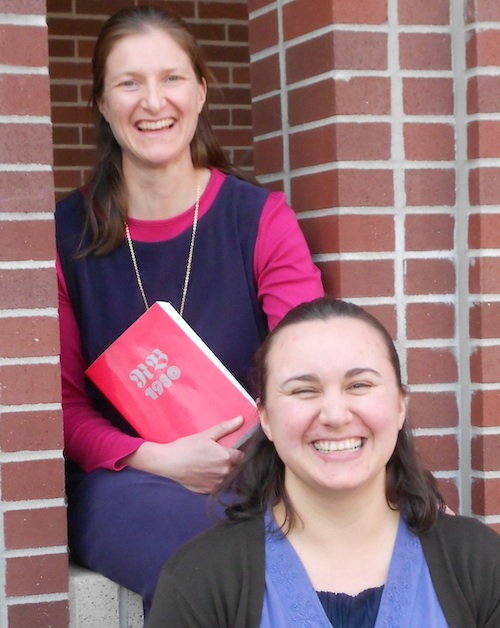
Do these kids look happy or what?   This picture was taken outside of a Marian Grotto we have on our property.  Now of course a field trip day always makes kids happy.  

The kids received a tour of our main chapel and relic chapel and then I gave them a little speech on where their communion breads come from.  The thing I love about 2nd graders is that they are pretty attentive (not sure what the attention span for an average 8 yr old is), do look at you, listen to what you are saying and aren't afraid to ask questions...perhaps with their teacher and parent chaperones hovering over them they do better.  :)  My experience with teen agers is often that they don't look at you and are pretending that they aren't interested in what you have to say lest their peers pick up on that and tease them.  However, once being a teenager myself, I can't hardly blame them!


I told them we use 100 pounds of flour and 16 gallons of water in each mix of batter.   In one week of production we use 5200 - 6500 pounds of flour and 832-1040 gallons of water.  We also produce approximately 2 million breads per week.   If you were to stack up all the breads we make in one week it would stretch 1.97 miles!   It is really a sacred work for our community to produce the bread that will be changed into the body of Christ.


The beauty of these kids is that the whole Eucharist experience is new for them.  They are excited to receive Jesus and proud to be one of the older crowd now.  They haven't been jaded by scandal in the church and they aren't arguing about church doctrine.  They are just happy to be receiving Jesus.  (Once you get through the scariness of your first confession, everything is pretty much downhill when you are 8 yrs old.)  These kids are the ones just doing what Jesus commanded 2000 years ago, "Do this in remembrance of me."   

 So what these kids teach me is to see the beauty of our Eucharist with fresh eyes.   As a daily Mass goer, I know that the Eucharist can lose it's luster when you receive every day.   I can take it for granted and be very complacent.  

As a Conception Abbey Monk used to say in his homilies to us - "those things you do daily, you do dully, unless you do them deeply."




Wednesday, April 10, 2013

Did St. Benedict really say THAT?

This past weekend my community celebrated one of our postulants moving on to the novitiate.   One sister remarked that it was significant to happen on Divine Mercy Sunday, "Let's pray your novice director has mercy on you!"   Poor Maria had to endure for the first couple of weeks after entering as a postulant hearing sisters sing, "How do you solve a problem like Maria?"  Not because she WAS a problem but because The Sound of Music is a perennial favorite movie of nuns.


Sr. Pat gives Maria the
Benedictine medal to wear during
her novitiate


Sr. Pat gives Maria a copy of
the Rule of St. Benedict 

Our dear holy father St. Benedict in his Rule starts out Chapter 58 (The Procedure for Receiving Members) by writing - "Do not grant newcomers an easy entry, but, as the Apostle says, Test the spirits to see if they are from God."   

It seems a little harsh to say that...it doesn't seem to be very inviting.  

Benedict apparently made those poor men stand outside knocking for 4 or 5 days and made them bear 'harsh treatment' to see if they had patience and persistence.  He doesn't describe what the 'harsh treatment' is, however.   Apparently it wasn't too devastating because men did enter the community.  

Candidates often remark to me, even in 2013, "You really don't make it very easy to enter religious life."   They are referring to the autobiography they have to write, various interviews and the dreaded psychological testing.  I've been tempted to make them wait outside the door but I'm sure my community would disapprove.  :0  "Whatever doesn't kill you makes you stronger," is not always a good maxim to live by!


Postulant Rosa shares in the
joy with new novice Maria.


Suffice it to say that while we do still have to test the spirits; we go about it in a more civilized manner  (I think).  Life in general tends to be enough of a tester without adding more to it!


Tuesday, April 2, 2013

Another year older...

Christos anesti!  Alithos anesti! (Greek)
Christ is risen!  He is truly risen!

I took a hiatus from by blog during Holy Week and the days of Triduum to enter into the quiet and meditate on the great events of the Paschal mystery.  Here we are now in Easter Week and I am one year older as of yesterday, the Feast of Fools, and as it so happens this year - Easter Monday.  If anybody wants to do the math, I was born in 1964.

Today I showed my age by coming in late for Lauds...accidentally, of course.  My clock radio/alarm was set but the volume was turned down so while it 'went off' at 5:10am I was awakened by the bells for Lauds at 6:30.   I knew I had less than 3 minutes to get to chapel so the adrenaline rush got me out of bed at least.

This has happened to me twice in my monastic life - which covers a 20 year time span so that isn't too bad a record.   On one occasion I dashed out of bed with my heart a pumpin', threw some clothes on and ran (as fleet as a deer) down the halls and arrived in chapel with about 30 seconds to spare.  The other previous time I lay in bed and said, "I'm never going to make it, now" so I decided to sleep a little longer.

Today, I knew I wouldn't make it but I am the organist so I knew showing up late was better than not showing up at all.   It's amazing how you can't find things right in front of your face when you are in a hurry.  My hair was a bit askew and I couldn't find my emblem (it was sitting in plain sight on my sink) but I managed to look at least presentable.  I did not rush madly down the stairs, (I'm more dignified in my 'old' age) but I did make it to chapel by the end of the opening hymn.   Apparently there was an awkward silence after the bells stopped ringing, which is when the organ usually intones "O Lord open my lips, and my mouth shall proclaim your praise."  Sisters were looking over at the organ wondering why nothing was happening.   Sr. Cheryl, another organist, covered things over by going to the piano and beginning Lauds when she realized I wasn't there.   Sr. Nancy Rose who is taking lessons to play the organ, was just hoping she didn't have to play because she hasn't learned the Lauds Office, yet.

I sheepishly strode in, signaled Cheryl I was there and was on the organ bench for the 2nd psalm.  Even St. Benedict in his holy Rule has a chapter on tardiness at the Work of God so things haven't changed much in 1500 years since he lived.

Thanks be to God my alarm did go off at 3:10am on Easter Sunday morning.  Our Easter Vigil began at the un-Godly hour of 4 am.  There is a reason I did not become a Trappistine - I didn't want to get up every morning to pray Vigils at 3:30am!  Usually I don't sleep well on a night like that because I'm worried I won't hear my alarm and I usually set another one as a back up.  But my alarm went off like it was supposed to.  I went down for just a bit of coffee to help the wake up process and stuck my head out the door to get a take on the early morning weather.  There had been a chance of rain.  It was chilly, but the stars were bright, the moon was shining, a great horned owl called into the night and the Spring Peepers were singing down in our lower pond.
Spring Peepers

As I stood there listening I smiled to myself and said, "It's a good day to rise...It's a good day to rise."


Sunday, March 17, 2013

Habemus Papam!

The first Latin American...the first Jesuit...the first Francis...

Jorge Bergoglio has a lot to live up to.  But what I have heard about him so far, he seems to be the right one for the job.

Last Wednesday we were just finishing up the noon dishes when a rumor spread that there had been white smoke.  Our TV room is on 2nd floor above the kitchen so we left the silverware behind and dashed up the stairs to see what was happening on TV.  (A couple of sisters on the dish crew nobly stayed back to at least dry the silverware and put it away...they did feel a bit abandoned but Pope Fever had taken hold.

When we got up there the TV reporters were saying it would be at least another 50 minutes before the new pope appeared.   Whew...all that excitement and then...waiting....

I plunked myself down in a chair to wait and listen to all the filler commentary.  I found myself glad and proud to be a Catholic as I looked out on St. Peter's Square and saw the crowds braving rain and cold weather to welcome the new pope.  "What other faith tradition has something like this?" I asked myself.  And what other faith would command such media coverage?  

I also found myself feeling sorry for the poor man who was now getting vested in the white robes of the pontiff.  I found myself praying silently in my heart for whoever it was.  What a load to carry!  So much scandal to deal with.  Nobody can ever be trained to be in charge of 1.2 billion people.  

When the cardinal came out and announced THE name, I couldn't make out anything recognizable as a name or a country.   I noticed the translators on TV didn't even translate it right away.   Our Sr. Lynn, who does not speak Italian, managed to be the first to figure it out.  I was pleased to have a non-European man selected and very pleased by the name of Francis.  

When he first appeared on the balcony I couldn't understand why he just 'stood there.'  "Why isn't he waving or gesturing to the crowd?" I thought to myself.   But then I thought, "What would you do if thousands of people were all looking at you?"  I would be like a deer stuck in the headlights.

Francis is a dangerous name to take - it's hard to live up to that one which is probably why no pope has ever picked it before.  

I just read where he spoke 'off the cuff' at his first Sunday window appearance and earlier that morning made an impromptu appearance before the public from a side gate of the Vatican, startling passers-by and prompting cheers, before delivering a six minute homily at St. Anna's, the Vatican's tiny parish church.  His security detail is not going to like this kind of activity, I'm sure!

The headlines at this time about the church are mostly about our new pope and generally positive.  In a short time this will be forgotten and other news will be fresher and more titillating.  The headlines will emphasize the scandals in our church again.  Or they will express how disappointed people are that the new pope isn't changing the teachings on abortion, gay marriage, etc.   

I plan to keep on praying for Pope Francis and for the Holy Spirit to guide him as he takes on this unimaginable job.


Sunday, March 10, 2013

White smoke on the horizon


Wow, these are exciting times in our Roman Catholic Church!  Our cardinals go into conclave on Tuesday to begin an election for a new pope.  An interesting note about the word conclave -  Origin: French from conclave, a room that may be locked up; con- + clavis key.
The election of popes has a storied and colorful history.
From Wikipedia:  To resolve prolonged deadlocks in the earlier years of papal elections, local authorities often resorted to the forced seclusion of the cardinal electors, such as that first adopted by the city of Rome in 1241.  In 1269, when the forced seclusion of the cardinals alone failed to produce a pope, the city of Viterbo refused to send in any materials except bread and water. When even this failed to produce a result, the townspeople removed the roof of the Palazzo dei Papi in their attempt to speed up the election.  
In an attempt to avoid future lengthy elections, Gregory X introduced stringent rules with the promulgation of Ubi periculum. Cardinals were to be secluded in a closed area and not accorded individual rooms. No cardinal was allowed, unless ill, to be attended by more than two servants. Food was supplied through a window to avoid outside contact.  After three days of the conclave, the cardinals were to receive only one dish a day; after another five days, they were to receive just bread and water. During the conclave, no cardinal was to receive any ecclesiastical revenue. 

Hmm...imagine being locked up until you come out with the answer.  What if we locked ourselves into a room while discerning religious life until we had the answer?  Not a good idea most probably...forced discernment isn’t proper discernment.  Besides, it took me three years to discern...I would have starved by then!

I must say, having been in the Sistine Chapel in 2008, if you are a Cardinal that must be an incredible place to sit and muse who should lead the world’s 1.2 billion Catholics.  The Last Judgment Scene that covers the wall behind the altar is a rather terrifying scene.  In the centre of the lower section are the angels of the Apocalypse who are waking the dead to the sound of long trumpets. On the left the risen recover their bodies as they ascend towards heaven (Resurrection of the flesh), on the right angels and devils fight over making the damned fall down to hell. Finally, at the bottom Charon with his oars, together with his devils, makes the damned get out of his boat to lead them before the infernal judge Minos, whose body is wrapped in the coils of the serpent.

If one seriously meditates on that, one would not take the election of supreme pontiff lightly.  

The stories in the Gospel remind us that sinners have always been in the church and will continue to be in the church, including our leaders.   My spiritual director related a story (not sure if it is true or not) about Pius VII and Napoleon.  Supposedly Napoleon had threatened to ‘bring down the church’ to which Pius VII replied, “If our priests have not managed to bring down the church in all these centuries, you will not be able to either.”  

The church is made of sinners and saints; mostly sinners.

Let's pray for wisdom and guidance for the Cardinals as they go into conclave on Tuesday.  

May they elect the man who can best guide us mostly sinners on our earthly journey to the Kingdom.


Sunday, March 3, 2013

Fig trees, Manure and the spiritual life


Excerpted from a reflection I gave at our Saturday Lenten vigil service.

This gospel of this 3rd Sunday of Lent (Luke 13:1-9) once again gives us that very biblical image of a fig tree.  At least in Luke's gospel, Jesus isn't cursing it because it hasn't bloomed as he does in Mark and Matthew.  Here, the fig tree gets another chance and extra care...but the threat of later being cut down still lingers.   

We have a sanitized translation where the gardener says he will cultivate around it and fertilize it.  The literal translation is manure.    The ancients were smart enough to know to use animal waste even if they might not have known why it was so helpful.  If you go into the Lawn and Garden section of Wal-Mart you can find numerous sacks of various fertilizers or boxes of plant food to meet all of your planting needs.   If you look carefully at the description of the fertilizer usually three alphabet letters will stand out - N, P, K.  These letters stand for nitrogen, phosphorus and potassium.   These are the three main ingredients that plants need.  Think of them as “up, down and all-around”.  Manure is extremely rich in these ingredients, especially nitrates.  


Nitrogen helps keep leaves green, promotes healthier blooms and aids in the manufacture of chlorophyll. Phosphorous is primarily responsible for keeping the trunk/stalk healthy and helps with root growth and development. Potassium is a general help to the entire plant. 

The phosphorus component of our lives helps our trunk/stalk and helps us put down strong roots.  I would think of this as our monastic, Catholic infrastructure - the Rule of Benedict, the teachings of our Catholic faith, the sacraments, our monastic horarium.  

The nitrogen component of our lives is what we can see - the leaves, the blossoms, the fruits we bear.  I would think of this as all the acts of our daily living, speaking words of charity, acts of kindness, faithfulness to the Divine Office, Mass, lectio and adoration; how we live in community.

The potassium component of our lives is whatever is a general help to us.  This will vary for each of us.  It is those things that we do that help our spiritual growth and deepen our relationship with God.   For some it might mean keeping more silence, for others it might be some sort of fasting.

If any one of these components is missing, the whole plant will suffer.  If we don’t have the right quantity of each, those parts of us don’t develop like they should.

The thought I would leave you with is to have you ask yourself:  What areas in my life may need a little more fertilizer or different fertilizer?  Do I need more nitrogen, phosphorus or potassium?    Am I honestly bearing any fruit at this time in my life?  Or am I just exhausting the soil?  ouch!!


Sunday, February 24, 2013

When was the last time you saw God's glory?

This second Sunday of Lent gives us the Gospel passage about the transfiguration.  Wouldn't that be something...to see God's glory...in dazzling, blinding light!

Our celebrant at Mass this morning started his homily with the question, "When was the last time you saw God's glory?"  

Hmmm....I thought to myself, I don't know that I ever have...at least not like we just heard in the Gospel.  What came to my mind first was the memory of our  snowstorm this past Wednesday and Thursday.  When the sun finally came out and lit up the landscape, it was rather blinding.  That was sort of an image of dazzling white, much like it says Jesus' clothes became while he was praying.  

But the glory of God is so much more.

In the bible it seems to produce the response of fright most often because it is just too overwhelming.   We don't know what to say.  Those types of manifestations of God have been few and far between for me.   I would venture to guess that it is the same for 99.9% of people who call themselves Christians.  God's preferred method seems to be subtlety.  Which I suppose is a good thing or we'd all be running around building tents (like Peter wanted to do).    God knows how easily frightened I am, I can be grateful he's a little sneaky.


view from my monastic 'cell'


I experienced his subtle glory when I heard robins and cardinals singing the past couple of days.  It's not necessarily unusual for this time of year but it's 20 degrees outside with snow on the ground!  What I like about birds is they follow the rhythms built into their DNA.  It is as if they say to themselves, "If I'm supposed to be in Clyde, MO in February and getting ready for spring, then that is where I will be, whether it feels like winter of not."

I experienced his subtle glory in the sunrise this morning.   I'm fortunate to have a bedroom that faces east so I can catch the first rays.

I experience his subtle glory taking a walk in the snow with a full moon overhead.

God's glory doesn't have to always be dazzling.  But we do have to have the proper eyes to see.  I hope you see God's glory in abundance this coming week!